 |
|
|
|
|
|
|
|
|
|
 |
 |
|
|||||||
 |
 |
 |
 |
 |
 |
 |
 |
|
|
|
|||||||||||||||||||
|
|
Galloways
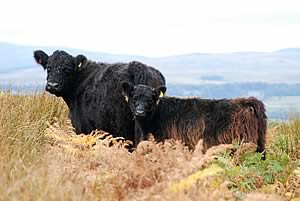
Paying Dividends at Hedgeley Hall A switch to an extensively run herd of pure Galloways has paid dividends in today’s de-coupled agriculture for a Northumberland estate.
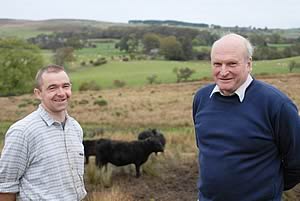
All enterprises run by John Carr-Ellison at Hedgeley Hall, Powburn, near Alnwick are benchmarked and fully-costed – this includes the 3,000 acres farmed in north Northumberland and the 51,000 acres in the Baltic states he either owns or manages. “Our Galloways are making a small profit. Looking at the net margins, rather than gross margins, the biggest benefit to us is the saving of fixed costs per head which EBLEX in its latest figures gives as £322 a head contributing to a net loss of £425 a head for LFA sucklers,” said Mr Carr-Ellison, who believes the hardy native breed also has a future in the Baltic states. The Galloways are out-performing the 100 cow suckler herd of Hereford and Angus cross Friesians producing intensively reared bull beef which they replaced four years ago. Hedgeley Estate runs to just under 4,000 acres in the Breamish Valley on the edge of the Northumberland National Park. It has one let farm, 500 acres of commercial forestry and the rest of the land is managed in hand in two units – a hill farm which runs 1,900 Blackface and Swaledale breeding sheep and the pedigree Galloway herd and their followers. The in-bye farm comprises 1,000 acres of arable land and runs 2,400 North Country Mule breeding sheep.
Hedgeley Farms was this year cited as a model for integration between commercial farming, conservation and diversification when it was awarded the Tye Trophy by the Yorkshire Agricultural Society. “The purpose of the cows is to utilise troughs in our labour force and to act as ‘scavengers’ using arable by-products,” said Mr Carr-Ellison. “About four years ago, with de-coupling on the horizon, I saw no future for the traditional type of suckler cow on an upland farm. It only made sense with high levels of production subsidies. Remove those and there was no future for the intensive suckler cow. “I was faced with either getting rid of the cattle altogether or turning the enterprise entirely on its head and look at a completely different system where we would go increasingly extensive and use the cheapest form of feed on the farm – grass and, in particular, poor quality grass – and that’s what we did. “I knew very little about Galloways and I still don’t but I know they are doing a job for us.” The aim was to produce high quality beef at a minimum cost as well as incorporating the Galloways into the fairly complicated system of agri-environment schemes. The hill farm is in the Higher Level Countryside Stewardship scheme with native breed cattle attracting a subsidy of £70 a ha. Galloways are non-selective grazers and help to control bracken and undesirable grasses such as Molina moor grass. The choice of native breed is a reversion to the days Mr Carr-Ellison remembers from his childhood when the Cheviot hills were full of Galloways, either black, Dun or Belted types. “They had evolved over the years to fill a particular niche in our hills. They were the same types that we used to ride over the Border and pinch from the Scots 450 years ago. “It was the interference with the market that resulted from our entry into the EU that completely distorted the cattle industry of this country. Production subsidies favoured continental cattle but take the subsidies away and the numbers simply don’t add up because of the increased inputs,” he said. The Highland cow was considered but felt to be too extreme for the conditions producing smaller carcases and the Galloway with equal hardiness was the choice. The Beanley Galloway herd was established four years ago with the purchase of two herds – the Blarcreen herd from Fred MacPherson, of Cairn Ryan and Mrs Dunlop’s unregistered pure bred herd at Hawick. “The cost per cow for the Galloways is running at around 35 per cent of what our intensive suckler herd ran at. We can make savings in feed by further incorporating the cattle system into our agri-environment schemes on the in bye farm, harvesting for silage our arable reversion land, six metre field margins and the pollen and nectar mix plots. “The cost of feeding the cattle is purely the baling cost and the wrap. “Manpower required for the cattle has greatly decreased – the most important thing is to catch the calves within 24 hours of birth to tag them and as far as intervention during calving is concerned it is very minimal. “Also time spent handling the heifers that are going to become breeding cattle pays dividends later.” Mr Carr-Ellison’s interests in the Baltic states of Estonia, Lithuania and Latvia go back 12 years. Until recently, his agricultural involvement has been in the arable sector, but since the countries joined the EU the domestic markets have changed dramatically. The economies are growing by eight to 10 per cent a year and currently wages at 28 per cent per year with the result that the standard of living is changing along with the demand for quality food stuffs. “I know that the Galloway would suit these countries very well. They will winter outside and deal with the vagaries of weather conditions. We are in the process of setting up two demonstration herds on farms in Estonia and Lithuania. “The biggest opportunities will be for the Galloway and the Aberdeen Angus, primarily because they are grazing breeds that can turn grass into high quality beef without reliance on a high concentrate diet. “There is already a huge interest among the farming communities in these areas. As suckler cow premium has come off in the UK it has been introduced in these countries in order to get their beef industry off the ground. These people are great triers and very hard workers.” While Mr Carr-Ellison says the economics of exporting large numbers of commercial females is too expensive, he is looking to export the nucleus of small pedigree herds of well-bred animals with good conformation, good feet and of reasonable size. Ironically, he says the livestock connection with the north of England and Scotland goes back centuries as most of the Latvian Brown cattle and Estonian Reds originated from imports of Dairy Shorthorns in the nineteenth century. Similarly, North Country Cheviots and Suffolks form the nucleus of the small sheep industry. The Beanley herd at Hedgeley is outwintered on Beanley Moor and on haugh land beside the River Breamish. They summer on the moor and on other hill farms in the Cheviots where they fit well with their hosts agri-environmental schemes. The cows thrive on the poorer quality grass of a hard hill of bog, peat, bracken and stone. They are fed poor quality silage or haylage which has come off the conservation ground. Calving begins in early March to coincide with the growing calves being able to maximise early grass growth in April. Calving is at three years old and some females not retained as replacements have been sold as bulled or bulling heifers. Cattle are finished at 20 to 26 months old, with the target at under 24 months. A batch of 20 sold averaged 591kg and killed out at 56.4 per cent. The finishing cattle are weighed regularly to monitor progress and sold when daily liveweight gain drops to near the cost of daily feed intake. Last year the breakeven DLWGwas 0.67kg. They sold for £2.20 a kg deadweight with a feed cost of 92p a head per day for finishing. Income from the youngstock pushes the loss of £30 a cow into profit. The estate manager Suzanne Horn is now exploring niche markets for the beef, working with local butchers. After being housed on store rations during the first winter after weaning, the cattle are introduced to a finishing ration at 18 months old which last year comprised of 45 per cent barley, 10 per cent sugar beet pulp, 15 per cent beans, 15 per cent potale, 15 per cent straw, beef minerals and propcorn.
|
||||||||||||||||||

|
|
||||||||||||||||||
| home | agri-services | pedigree
pen | news | dairy | beef | machinery property | organisations | site map |
|||||||||||||||||||
|
|
|
|
|
|
|
|
|
|
|
|
|
|
|
|
|
|||


Article by
Jennifer MacKenzie