|
|
|
|
|
|
|
|
|
|
 |
 |
|
|||||||
 |
 |
 |
 |
 |
 |
 |
 |
|
|
|
|||||||||||||||||||
|
|
Scottish
Farmers Co-ops to Help Tackle Climate Change A benchmark survey carried out by SAOS as part of a Carbon Trust Networks project has established that farmers can cut their carbon footprint and save money.
The five farmer co-operatives involved in the project are: Borders Machinery Ring, Scottish Agronomy, North Highland Products, HBS Ring and Tayforth Machinery Ring. The benchmark survey found that the average carbon dioxide (CO2) Greenhouse gases are produced from three main sources on a farm: Methane, from livestock; nitrous oxide, produced through the use of mineral fertiliser and animal manures; CO2 is produced by burning fossil fuels and using electricity. Methane and nitrous oxide are powerful greenhouse gases. 1 kg of methane has the equivalent warming effect of 26 kgs of CO2 and 1kg of nitrous oxide has the equivalent warming effect of 296 kgs of CO2. emissions across the 10 farms surveyed was 3.85 tonnes of CO2 equivalent per hectare. The outputs varied enormously from farm to farm depending upon the overall output and the different enterprises. The main sources of emissions were attributed to the methane produced from livestock, nitrous oxide produced through the use of mineral fertiliser and animal manures, and CO2 from burning fossil fuels and using electricity. Hamish Walls, of SAOS, commented: “The benchmark survey allows us to see where carbon emission reductions can be made on farms, simultaneously providing financial benefits for the business. The survey also found that many farmers are very keen to understand how this can be achieved, which is what the Carbon Trust Networks project is all about.” A prime example is the use of fertiliser. The survey found
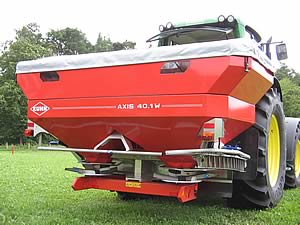
that while many farmers will ensure the correct volume
of fertiliser is spread on field, the spread pattern itself
may not have been checked. A simple test can find the optimum
spread pattern, ensuring maximum use of fertiliser applied
and therefore reduced nitrous oxide emissions. As well
as making a contribution to reducing Scotland’s greenhouse
gas emissions, this also delivers a cost savings to farmers. To help farmers understand more about carbon management alongside the five farmer co-operative partners, SAOS will be holding a series of lunchtime seminars in January 2008, supported by the Carbon Trust Scotland. These seminars will give farmers the opportunity to calculate their own carbon footprint using a web-based calculator, as well as receive some environmental and money saving information.
|
||||||||||||||||||

|
|
||||||||||||||||||
| home | agri-services | pedigree
pen | news | dairy | beef | machinery property | organisations | site map |
|||||||||||||||||||
|
|
|
|
|
|
|
|
|
|
|
|
|
|
|
|
|
|||


 |